
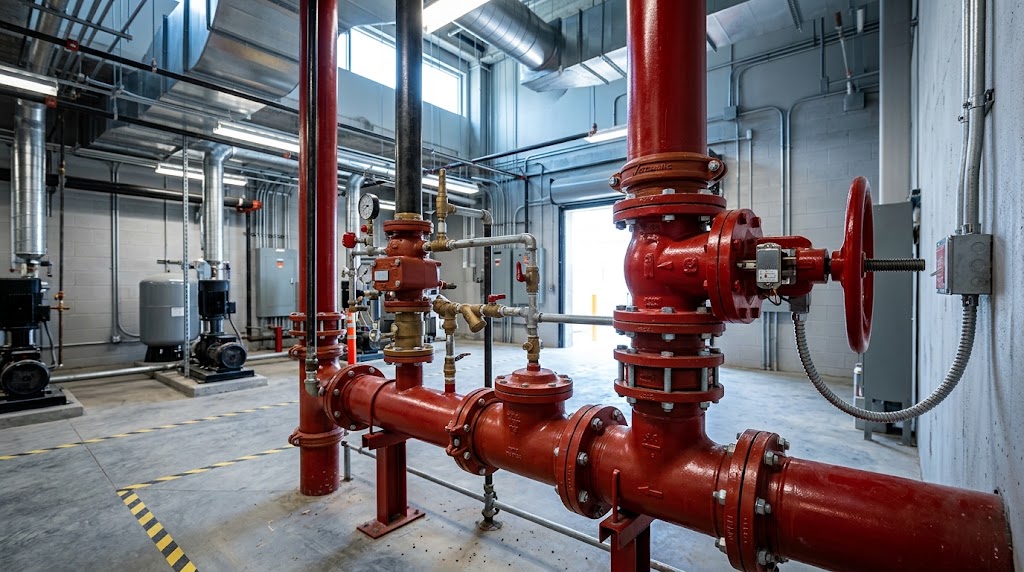
Why Are Fire Protection Valves Essential to System Readiness?
Water-based fire protection systems rely on a network of interconnected components, beginning with the water supply and fire pumps and continuing through piping, control valves, sprinkler systems, and firefighting connections.
While significant attention is often given to fire pumps and sprinklers, the position of a single control valve can determine whether water reaches a protected area during an emergency.
For this reason, proper valve installation alone is not enough. Facility teams must also verify operating positions, accessibility, mechanical condition, supervisory arrangements, and inspection and maintenance practices.
Fire pumps may be operational and sprinklers may be in good condition, but a closed control valve in a location that must remain open can prevent water from reaching part of the fire protection network.
What Functions Do Valves Perform in Fire Protection Systems?
Fire protection valves are designed for different purposes. Some control or isolate water supplies, others prevent reverse flow, while additional valves are used for testing, draining, or specific operating arrangements.
Valve selection and placement depend on the system design, operating pressures, flow requirements, and applicable project specifications.
Manage water supply and allow designated sections of the system to be isolated when necessary for inspection, maintenance, or repairs.
Help prevent unwanted reverse water flow according to the valve’s intended function and location within the system.
Support specified testing and drainage operations according to system design and approved maintenance procedures.
Allow changes in control valve position to be monitored using supervisory devices connected to an appropriate monitoring or fire alarm system.
What Happens When a Control Valve Is Closed Without Proper Follow-Up?
Closing a main or sectional control valve can interrupt the water supply to part of a protected building. This may happen during maintenance, system modifications, or unintended operation.
The risk becomes greater when normal building operations resume without restoring the valve to its required position or documenting the affected system impairment.
- Water supply to a protected sprinkler zone may be interrupted.
- Firefighting connections served by the isolated section may be affected.
- Part of the fire protection system may remain out of service without the operations team realizing it.
- Corrective action may be delayed by inadequate records or communication.
- The situation may require formal fire protection system impairment procedures.
How Does Valve Supervision Support Fire Safety?
Certain fire protection control valves are equipped with supervisory devices, commonly referred to as tamper switches, which monitor changes from the valve’s required operating position.
These devices may be connected to an approved fire alarm or monitoring system to generate a supervisory signal when the monitored condition changes, according to the system configuration and programming.
A supervisory signal generated by a valve position change is not necessarily a fire alarm signal. Its indication and the required response must follow the system design and applicable requirements.
What Should Facility and Maintenance Teams Inspect?
Fire protection valves require inspection and maintenance programs appropriate to their function and the importance of the network sections they control.
Reviews should include operating positions, accessibility, visible condition, supervisory devices, and maintenance records.
Confirm that each valve is in the required position according to approved system drawings and operating procedures.
Verify that equipment, stored materials, and other obstructions do not restrict access to valves and supervisory devices.
Check for visible leakage, corrosion, damage, and abnormal conditions, with required testing carried out by qualified personnel.
Review inspection reports, document operational changes, and confirm supervisory device functionality where installed.
Common Mistakes in Fire Protection Valve Management
Some significant fire protection readiness issues result from routine operational mistakes rather than major equipment failures.
- Closing a valve for maintenance and failing to restore its required operating position.
- Not identifying the valve or the protected area it controls.
- Allowing stored materials or equipment to obstruct valve access.
- Ignoring supervisory signals from valve monitoring devices.
- Relying exclusively on visual checks instead of following the required inspection, testing, and maintenance program.
- Failing to implement appropriate impairment procedures when part of the fire protection system is taken out of service.
How Should the Right Valve Be Selected for a Project?
Fire protection valve selection depends on engineering specifications, system configuration, installation conditions, working pressure, pipe dimensions, and material compatibility.
Some projects require valves with specific certifications or approvals, including UL Listed or FM Approved models. It is essential to verify the exact product model and its intended application rather than assuming that every product from a manufacturer carries the same approval.
Engineers must also consider compatibility with connected components, operating arrangements, supervision requirements, and long-term maintenance access.
Falcon Power Recommendation
Falcon Power emphasizes that fire protection control valves should be managed as critical operating components rather than passive accessories within the piping network.
Effective valve management includes proper engineering selection, installation according to approved drawings, position supervision where required, scheduled inspections and testing, and accurate documentation of maintenance activities.
Complete system readiness depends on fire pumps, valves, piping, alarm devices, and firefighting outlets functioning together as part of an integrated and properly maintained fire protection system.