
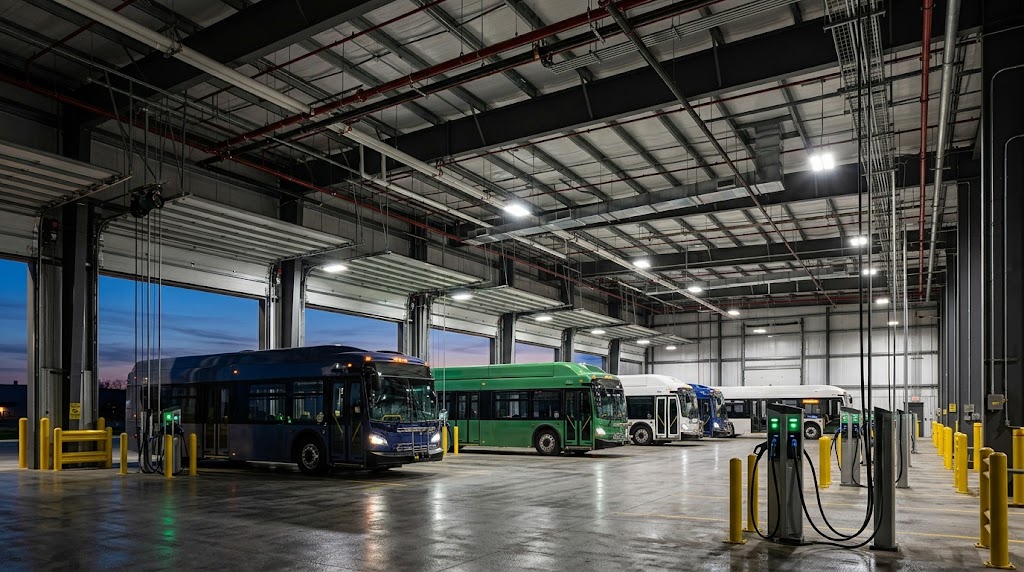
Why Are Electric Bus Depots Becoming a Fire Safety Priority?
As public transport operators transition toward electric fleets, fire safety planning is becoming an increasingly important part of depot design, charging infrastructure, and daily operations.
In September 2026, the National Fire Protection Association (NFPA) published a discussion highlighting research into the fire prevention and risk management challenges associated with lithium-ion battery-powered transit buses and their depots.
Electrifying a transit fleet involves more than changing the vehicles’ power source. Operators must also assess fire scenarios, charging arrangements, maintenance facilities, emergency procedures, and the suitability of existing fire protection systems.
What Fire Risks Require Further Assessment?
Certain lithium-ion battery fire scenarios differ from those associated with conventional diesel-powered vehicles. Potential concerns include thermal runaway, fire propagation, hazardous gases, difficult-to-access battery components, and possible reignition.
Therefore, a fire protection strategy designed for a conventional bus depot should not automatically be assumed suitable for an electric bus facility without an appropriate engineering assessment.
- Review charging station locations and bus parking arrangements.
- Assess potential fire spread between adjacent vehicles.
- Evaluate fire detection, alarm, and monitoring capabilities.
- Review suppression, water supply, ventilation, and smoke management systems.
- Develop procedures for isolation, emergency access, and incident response.
Key Fire Safety Readiness Considerations
Examine vehicle characteristics, battery systems, charging equipment, and depot layouts to identify credible fire scenarios.
Evaluate appropriate detection technologies, coverage of charging and maintenance areas, and communication of emergency signals.
Review the suitability of sprinkler systems, fire pumps, water supplies, and other fixed protection measures against identified hazards.
Establish procedures for charging shutdown, safe electrical isolation where appropriate, personnel evacuation, and coordination with emergency responders.
Are Conventional Fire Protection Systems Sufficient?
There is no single answer for every electric bus depot. The effectiveness of a protection strategy depends on facility construction, battery and vehicle characteristics, charging methods, vehicle spacing, and identified fire scenarios.
Fire sprinklers, fire pumps, alarm systems, and ventilation may remain important elements of a comprehensive strategy. However, their required performance, configuration, and suitability must be established through qualified engineering evaluation.
No individual suppression technology should be presented as a universally guaranteed solution for all lithium-ion battery fires. Protection measures must be selected according to the relevant hazards, technical evidence, and applicable requirements.
What Does This Mean for New Projects?
Fire protection requirements should be considered early in the planning and design of electric transit depots, rather than being addressed only after civil and electrical infrastructure has been finalized.
Coordination among fire protection engineers, electrical and mechanical designers, and fleet operators can help address charger locations, fire protection networks, emergency access, vehicle isolation areas, and response requirements.
Falcon Power Perspective
Falcon Power emphasizes the importance of assessing the actual fire hazards of emerging facilities before determining suitable protection equipment and systems.
Selecting fire pumps, detection and alarm systems, and safety equipment should form part of a broader fire protection strategy that integrates engineering design with operation, maintenance, and emergency preparedness.